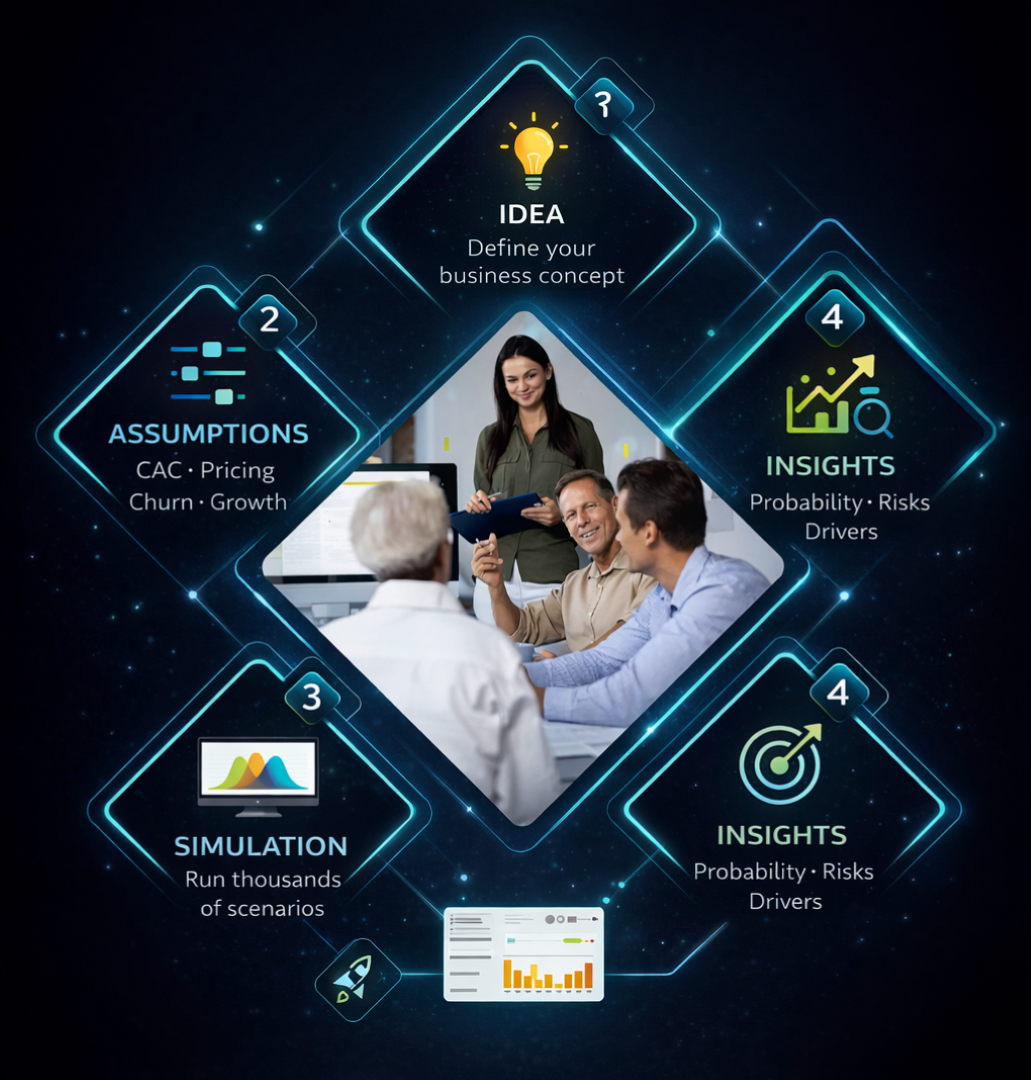
Meet Idea Simulator — a simple way for founders to test business ideas before they burn time and money
Introducing Idea Simulator — Monte Carlo & System Dynamics for Startup Ideas
Every ambitious idea starts with a story:
• “If we price at $X, we’ll grow fast.”
• “Churn will be low because the product is sticky.”
• “CAC will drop once word-of-mouth kicks in.”
• “We’ll break even by month 12.”
The problem isn’t that these statements are wrong. The problem is that they’re uncertain—and most teams still plan as if uncertainty doesn’t exist.
Idea Simulator (ideasimulator dot io) was built for this exact moment: when you need to turn assumptions into a range of outcomes, understand the probability of hitting targets, and identify the few variables that actually matter—before you spend months building, hiring, or fundraising. (ideasimulator.io)
What is Idea Simulator?
Idea Simulator is a simulation workspace for startup and product ideas that combines:
• Monte Carlo simulation for fast probabilistic forecasts
• System Dynamics for modeling feedback loops over time
• Scenario comparisons, sensitivity analysis, and exportable reporting for decisions and stakeholder alignment (ideasimulator.io)
Instead of producing a single “best guess” spreadsheet, Idea Simulator helps you answer better questions:
• What’s the probability we reach profitability by month 18?
• Which assumption drives the most downside risk: churn, CAC, ARPU, or costs?
• How different does the outcome look under a conservative vs aggressive scenario?
• What happens when uncertainty compounds over time?
This is not “planning for certainty.” This is planning for reality.
The core idea: outcomes are distributions, not single numbers
A Monte Carlo approach models uncertainty by sampling many possible values for your inputs and repeatedly running the model to generate a distribution of outcomes—so you can see not only what might happen, but what’s likely. (Investopedia)
In Idea Simulator, that looks like:
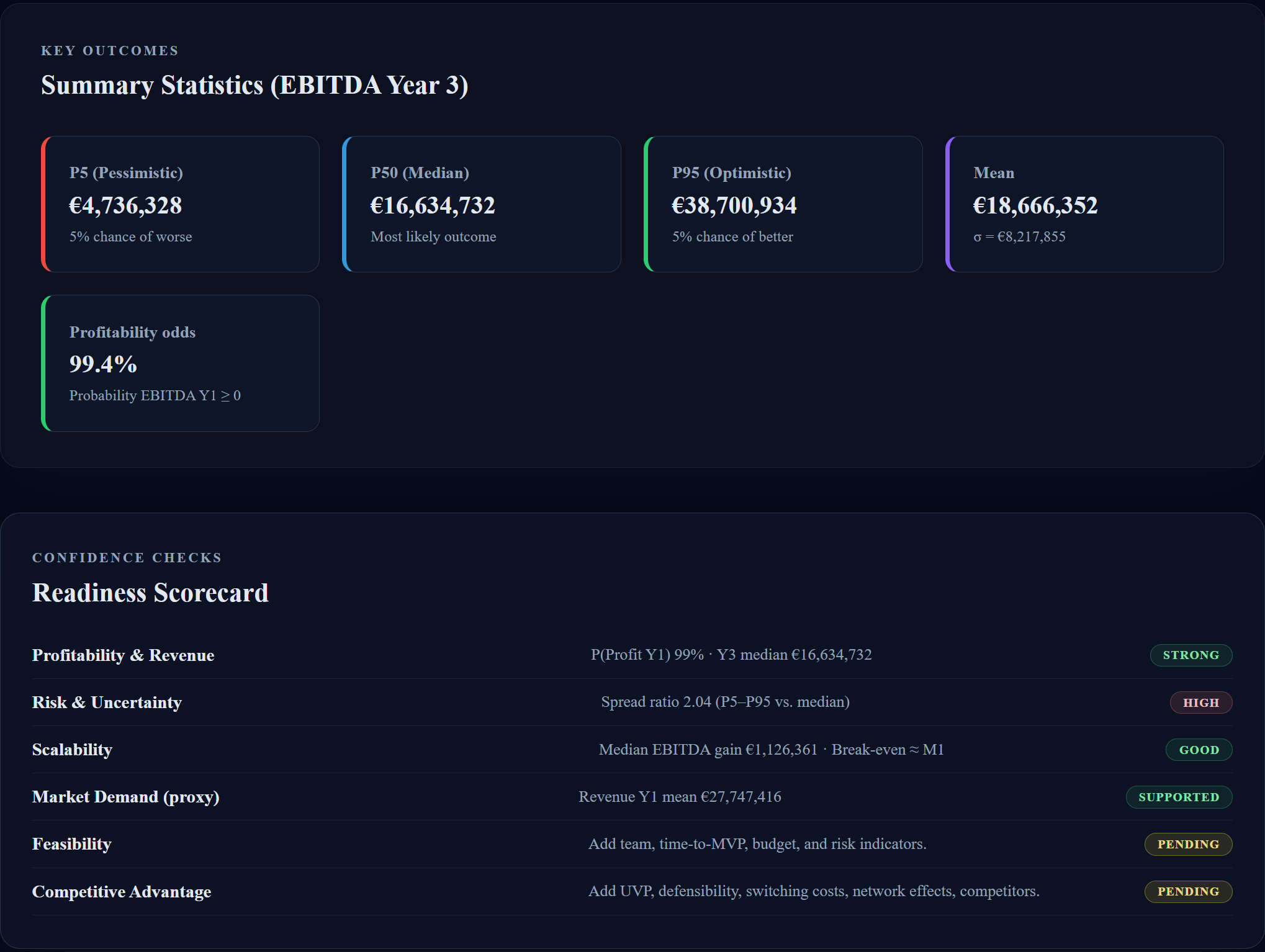
• Percentile bands (think P5 / P50 / P95-style thinking)
• Sensitivity insights that surface your biggest levers
• Scenario comparisons you can bring to a product review, board meeting, or investor update (ideasimulator.io)
A workflow designed for founders and product teams (not statisticians)
You can start with a quick simulation run, or build a deeper idea workspace. The platform’s learning workflow lays it out clearly:
-
Create a new idea (name, description, currency)
-
Complete a Lean Canvas (problem, solution, UVP, segments, channels, revenue, costs, metrics, competition)
-
Quantify KPIs & assumptions (customers, ARPU, CAC, churn, budgets, market sizing)
-
Run simulations and compare scenarios (with exporting and sharing options expanding across plans and roadmap) (ideasimulator.io)
This matters because most validation tools stop at generic advice. Idea Simulator pushes you toward a practical question:
“What do I believe… and what happens if I’m wrong?”
Try it instantly: an interactive demo that runs the real simulation endpoint
If you want to see the engine in action before creating an account, Idea Simulator provides an interactive demo where you can adjust core assumptions like:
• ARPU
• Churn
• Customers
• CAC
• Fixed costs
• Marketing spend
…and watch the outcome cloud shift in real time. The demo includes choices like sampling methods (including LHS and Sobol) and multiple model engine modes. (ideasimulator.io)
This is a powerful way to move from “I think…” to “I can quantify what that means.”
Choosing the right model: Monte Carlo vs System Dynamics (and what’s next)
Idea Simulator doesn’t force one modeling style. It helps you pick the tool that matches the question.
1) Monte Carlo (fast, probabilistic, decision-ready)
Best for:
• Financial projections with uncertain inputs
• Risk analysis and probability ranges
• Sensitivity checks across key assumptions (ideasimulator.io)
2) System Dynamics (structural insight + feedback loops)
Best for:
• Adoption and retention dynamics
• Scenarios where delays and reinforcing loops matter
• Explaining why KPIs change over time—not just how much (ideasimulator.io)
3) Agent-based modeling (coming in phases)
Best for:
• Network effects and referral loops
• Marketplace matching
• Heterogeneous cohorts and peer influence (where behavior emerges from micro-rules) (ideasimulator.io)
The big takeaway: you can start simple, then model deeper structure as your understanding grows.
Insights that turn simulation into action
Simulation is only valuable if it drives decisions. That’s why Idea Simulator emphasizes interpretation and communication, not just computation.
Available insight capabilities include:
-
-
Scenario comparisons (best/base/downside) tied to business outcomes
-
Sensitivity heatmaps to identify which variables drive the distribution
-
Investor-ready exports to generate narrative-ready charts and commentary
-
A readiness scorecard that evolves as you refine inputs and evidence (ideasimulator.io)
-
This is especially useful for:
-
-
Product and growth teams deciding what to test next
-
Founders prioritizing validation experiments
-
Venture studios comparing multiple opportunities side-by-side (ideasimulator.io)
-
Integrations and API: bring your data in, push your decisions out
Idea Simulator is building toward a connected workflow where assumptions are not trapped in static files.
Current and planned integrations include:
-
-
Google Sheets (available) for syncing spreadsheets into simulation variables
-
Notion (in beta) to connect discovery notes and hypotheses
-
Planned connectors like Segment, Salesforce, Slack, and Jira (ideasimulator.io)
-
For teams that want automation and deeper control, the platform also provides OpenAPI documentation and a workspace-accessible API reference. (ideasimulator.io)
Trust matters: data ownership, privacy, and responsible use
When you simulate business ideas, you’re working with sensitive strategic thinking. Idea Simulator addresses that directly:
-
-
The Terms state you own the ideas, variables, and simulation results you upload. (ideasimulator.io)
-
The Privacy Policy states the platform does not sell personal data, and describes encryption and access controls. (ideasimulator.io)
-
The Terms also clarify that outputs shouldn’t be misrepresented as investment advice—because the goal is decision support, not false certainty. (ideasimulator.io)
-
(For many teams, this clarity is the difference between “cool tool” and “we can actually use this in the real world.”)
Who is Idea Simulator for?
If your work depends on making good decisions with incomplete information, you’re the audience.
Idea Simulator is built for:
-
-
Startup founders validating a concept before building
-
Product managers and growth teams planning roadmaps under uncertainty
-
Venture studios and accelerators comparing ideas across a portfolio
-
Innovation teams turning strategy into measurable experiments (ideasimulator.io)
-
The invitation: simulate before you commit
The fastest teams aren’t the ones that move on vibes.
They’re the ones who:
-
write down assumptions,
-
quantify uncertainty,
-
run scenarios,
-
test the biggest levers first.
That’s the mindset Idea Simulator is designed to support—one idea, one model, one iteration at a time. (ideasimulator.io)
If you’re ready to stop guessing and start stress-testing, create an account on Idea Simulator (ideasimulator dot io) and run your first simulation.