Why Founders Struggle With Financial Projections — And How to Validate Your Business Idea and Fix It
One of the biggest fears founders have when preparing a pitch deck isn’t the idea. It’s the financial projections. Questions like these suddenly appear:
- • How fast will we grow?
- • What will our revenue look like in 3 years?
- • When do we break even?
- • What happens if our assumptions are wrong?
Most founders try to answer these questions with one spreadsheet and one forecast. But real businesses don’t follow one path. Customer acquisition costs change. Churn changes. Growth slows down. Markets evolve.
The Limitations of Traditional Startup Spreadsheets
Traditional financial models assume a linear path. For example:
- • Revenue grows at a fixed rate.
- • Costs increase predictably.
- • Customer growth follows a steady trend.
In reality, startup growth is rarely linear. Small changes in assumptions, such as customer acquisition cost or retention can dramatically affect the outcome. This is why many founders feel that financial projections are more like educated guesses than reliable planning tools.
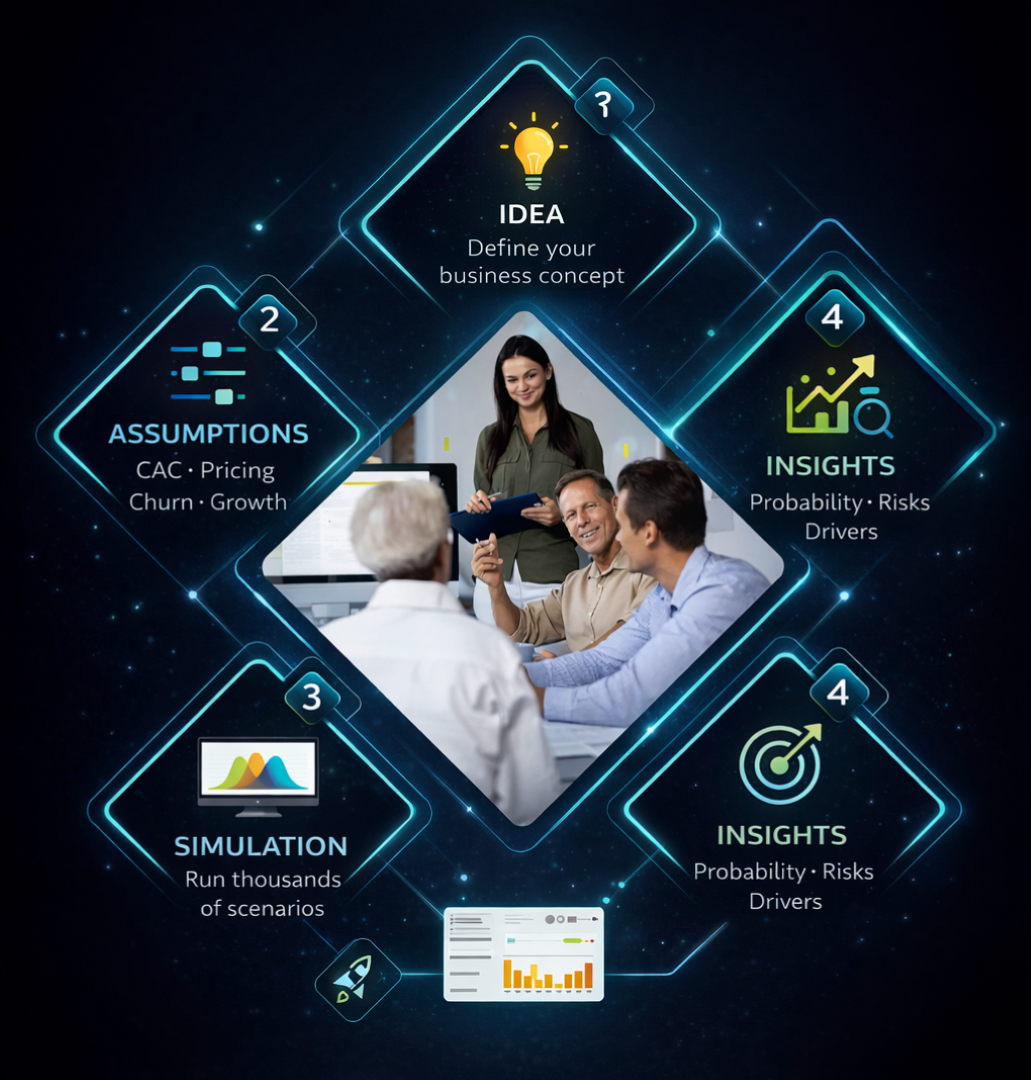
This approach turns financial modeling from guessing into learning. That’s exactly why we built Idea Simulator (ideasimulator.io). The platform helps founders:
- • Structure their business idea
- • Define key assumptions
- • Simulate growth scenarios
- • Understand risk and upside
Instead of saying:
“Here’s our best guess.”
You can say:
“Here’s how the business behaves under different conditions.”
And that makes investor conversations much easier.
How Idea Simulation Changes the Process
Instead of predicting one future, idea simulation explores many possible futures. By running multiple scenarios, founders can see how their startup performs under different conditions. This approach helps answer critical questions such as:
- • What happens if marketing costs increase?
- • What happens if growth slows down?
- • What happens if pricing changes?
So defending one perfect projection can feel stressful. That’s where idea simulation becomes powerful. Instead of predicting a single future, simulation allows founders to test many possible outcomes. You can see:
- • Likely growth scenarios
- • Downside risks
- • Revenue sensitivity
- • Probability of success
Why Investors Appreciate Simulation-Based Thinking
Investors understand that startups operate under uncertainty. What they look for is not perfect predictions, but thoughtful assumptions and clear risk awareness. When founders present simulation-driven insights, they demonstrate:
- • Analytical thinking
- • Understanding of risk
- • Realistic planning
- • Stronger strategic decision-making
This makes conversations with investors, sponsors, and accelerators much more productive. If you're building a startup, preparing a pitch, or applying to an accelerator, this can change how you approach financial planning. You can try it here:- ideasimulator.io