How to Simulate and Validate Your Business Idea — Before Spending a Dollar
Every founder knows this moment. You have a business idea that feels promising. Maybe it’s a SaaS product, a marketplace, a fintech platform, or a local service with huge potential. You start asking yourself:
- • Will customers actually pay for this?
- • How fast could the business grow?
- • What if marketing costs are higher than expected?
- • What if customers leave faster than planned?

Most entrepreneurs answer these questions using a spreadsheet and optimism. But today, founders have a better option. You can simulate your business idea before investing time and money. And that is exactly what Idea Simulator (ideasimulator.io) was built for.
The Hidden Risk in Most Startup Plans
Most startup plans follow a simple structure:
- 1. Estimate how many customers you will get
- 2. Estimate how much they will pay
- 3. Estimate costs
- 4. Calculate profits
The problem? These numbers are guesses. And when one assumption changes — everything changes. For example:
- • Customer Acquisition Cost (CAC) increases
- • Churn (customers leaving) becomes higher
- • Pricing must be reduced
- • Growth takes longer than expected
A traditional business plan only shows one future. Real businesses operate in many possible futures.
What Is Business Idea Simulation?
Business idea simulation means testing your business idea under many possible scenarios.
Instead of asking:
“What happens if everything goes perfectly?”
You ask:
“What happens if reality changes?”
For example:
- • What if marketing costs double?
- • What if growth is slower?
- • What if churn increases?
- • What if pricing changes?
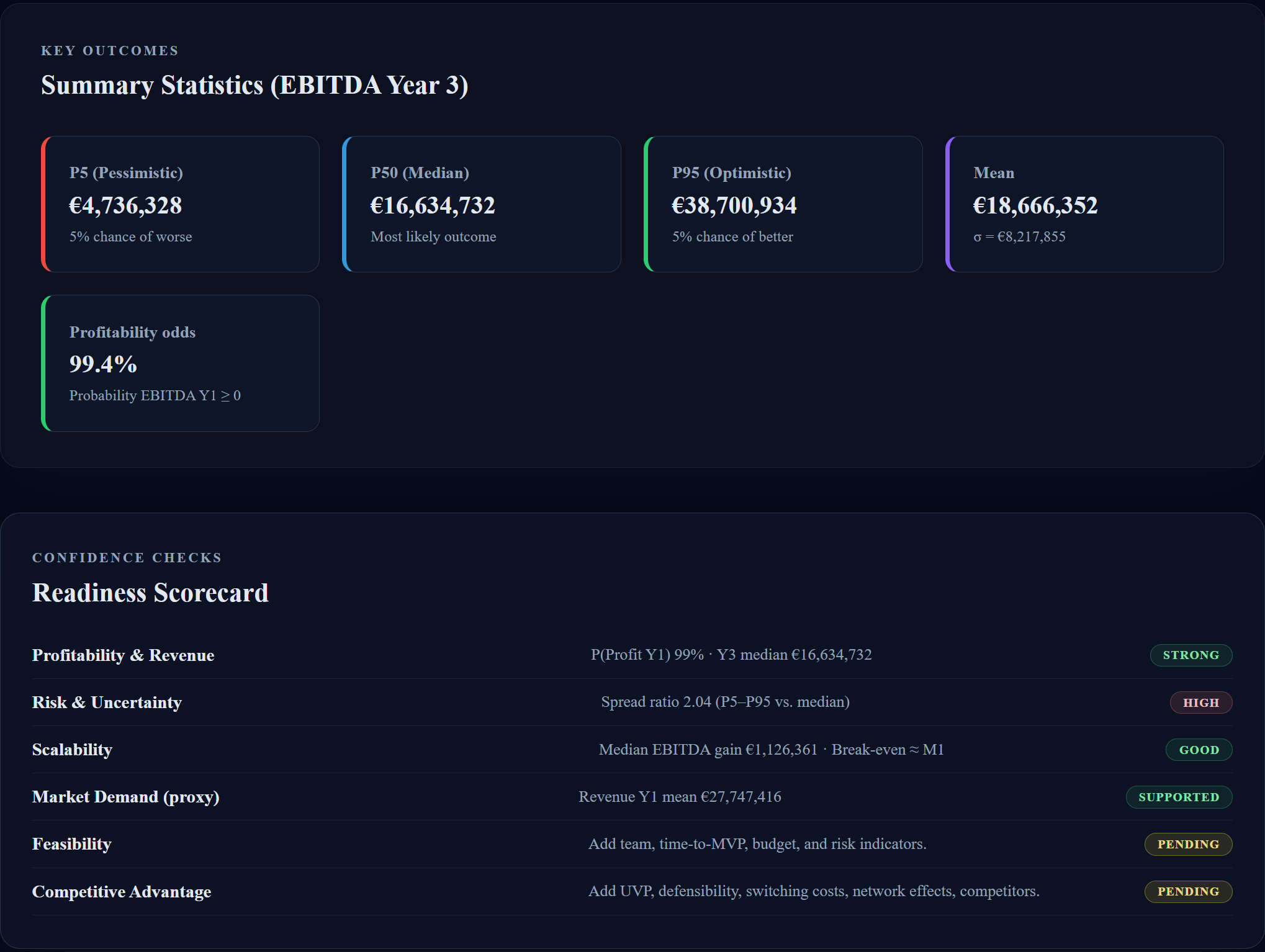
By simulating different scenarios, you can understand:
- • The probability of success
- • The biggest risks in your model
- • Which assumptions matter most
This approach is commonly used in finance, engineering, and strategic planning — but until recently it was hard for entrepreneurs to access.
Introducing Idea Simulator
Idea Simulator (ideasimulator.io) is a platform designed to help founders, entrepreneurs, and innovation programs simulate and validate business ideas before building them. Instead of relying on one spreadsheet forecast, the platform allows you to:
- • Define your business idea
- • Enter key assumptions
- • Run simulations
- • Explore multiple possible outcomes
This allows you to test your idea virtually before investing real money.
How Idea Simulator Helps You Validate an Idea
The platform follows a simple workflow.
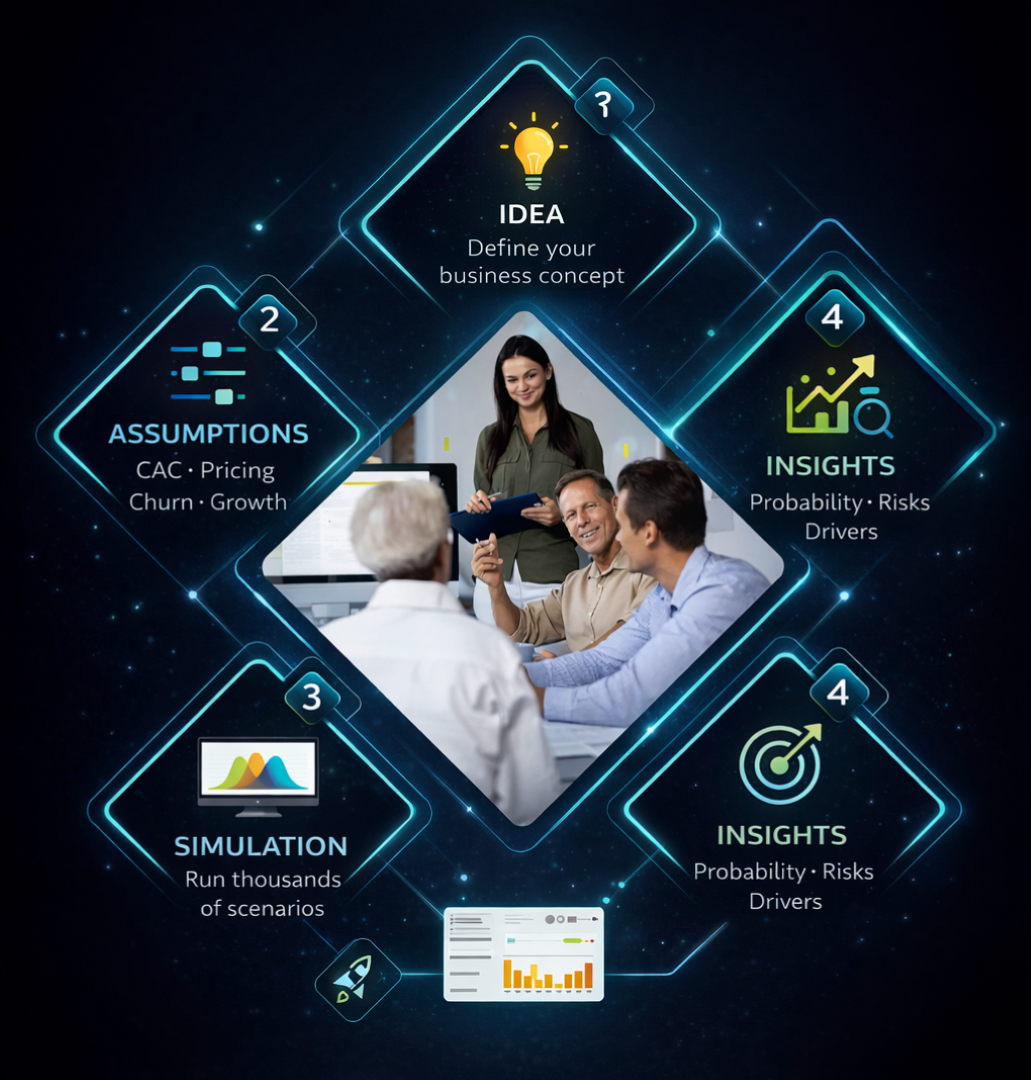
1. Define Your Idea
Start by describing your business concept. This may include:
- • Target customers
- • Value proposition
- • Revenue model
- • Key metrics
This helps structure the idea clearly.
2. Add Key Assumptions
Next you define the important variables in your business model. For example:
- • Customer Acquisition Cost (CAC)
- • Average Revenue Per User (ARPU)
- • Churn rate
- • Growth rate
- • Marketing spend
- • Operating costs
These assumptions shape your business model.
3. Run Simulations
Once assumptions are set, Idea Simulator runs simulations to explore different outcomes. Instead of one prediction, you see multiple scenarios. For example:
- • optimistic growth
- • moderate growth
- • slower adoption
- • higher marketing costs
This helps founders understand how resilient their idea is.
4. Discover What Really Matters
One of the most powerful insights from simulation is learning:
Which variables influence your success the most.
For example:
- • Pricing might matter more than marketing
- • Retention might matter more than acquisition
- • Costs might matter less than expected
This allows founders to focus on the right experiments first.
Why This Matters for Startup Programs and Incubators
Startup programs and business competitions often evaluate hundreds of ideas. But judging early-stage ideas can be difficult because most plans are based on assumptions rather than evidence.
Idea simulation introduces a new approach. Instead of evaluating:
“Who has the best pitch?”
Programs can evaluate:
- • Which ideas are most resilient
- • Which models have the strongest probability of success
- • Which assumptions need validation
This helps incubators and accelerators guide founders toward smarter experiments.
Why Founders Should Simulate Before Building
Building a startup requires time, energy, and capital. Simulation helps founders answer critical questions early:
- • Is this business model viable?
- • What assumptions must be tested first?
- • What risks could break the business?
- • What growth path is realistic?
This doesn’t replace execution. But it improves decision making before execution.
A New Way to Think About Entrepreneurship
The future of entrepreneurship is not just about building fast. It is about learning faster. Instead of building blindly and hoping for traction, founders can:
- 1. Model ideas
- 2. Simulate scenarios
- 3. Identify risks
- 4. Test the right assumptions
Idea Simulator helps make this process accessible to everyone.
Start Simulating Your Ideas
If you are a:
- • founder
- • entrepreneur
- • startup team
- • incubator
- • accelerator
- • innovation program
- • business competition organizer
Idea Simulator provides a new way to evaluate and strengthen business ideas before launching them.
Instead of asking “Will this idea work?”
You can start asking:
“Under what conditions will this idea succeed?”
Try the platform at: https://ideasimulator.io
Simulate your ideas. Test your assumptions. Build smarter.